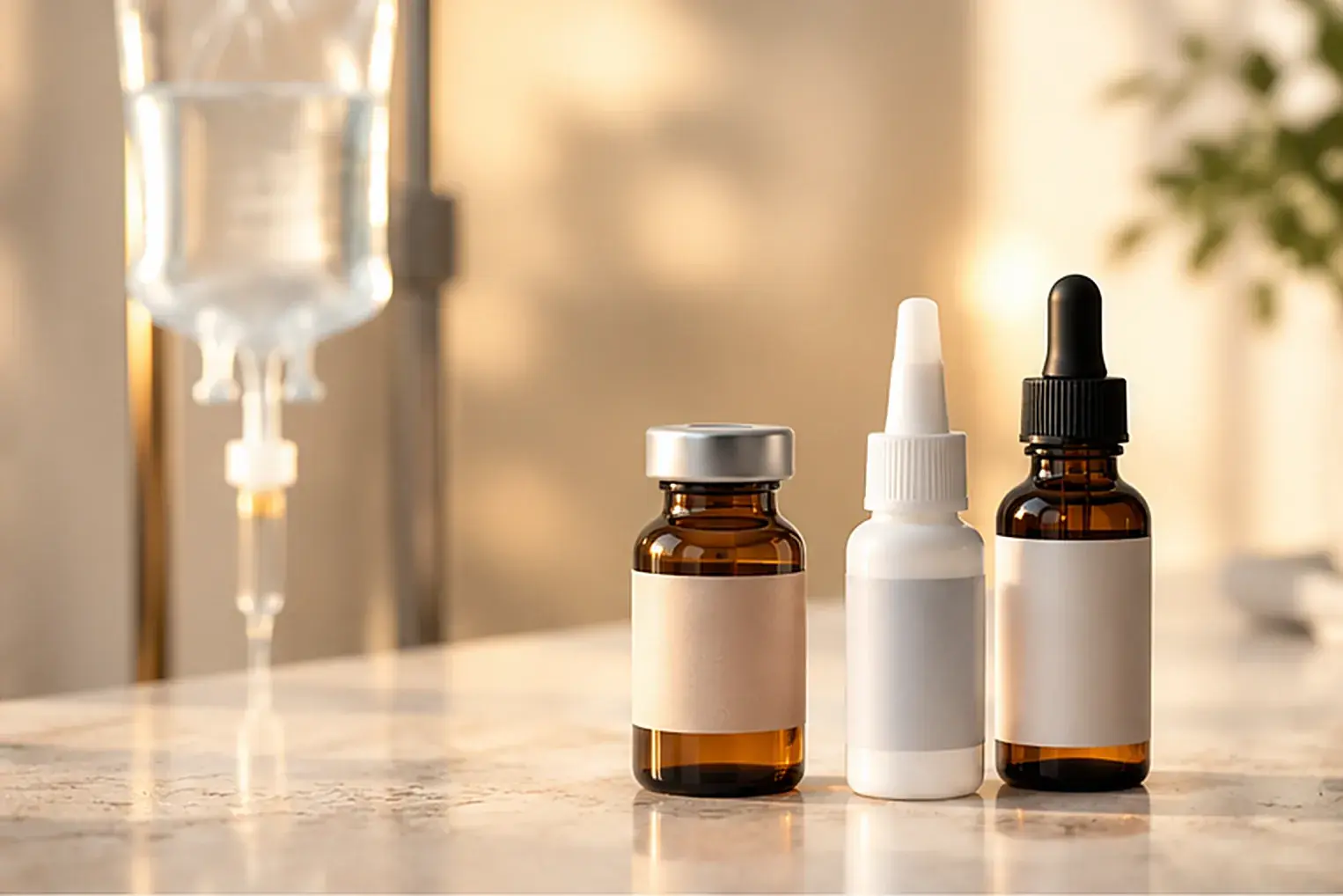
The short answer: NAD+ IV drips deliver NAD+ straight into a vein but take hours in a clinic and often cost hundreds of dollars a visit. At-home NAD+ injections take seconds, nasal sprays and oral liposomal NAD+ are needle-free, and NMN or NR supplements are precursors your body has to convert first. At Tides, the injection is $199 every 4 weeks and the nasal spray and oral NAD+ (liposomal) are $229 every 4 weeks. Longer plans go as low as $109 every 4 weeks with a 12-month plan.
Why people take NAD+
NAD+ (nicotinamide adenine dinucleotide) is a coenzyme found in every cell. Your cells use it to turn food into energy and to power hundreds of other reactions, including DNA repair. Levels naturally fall with age, which is why NAD+ has become one of the most talked-about tools in longevity science. People most often use it for steadier energy, sharper focus, and healthy aging. For the full background, read our complete guide to NAD+.
There are several ways to raise NAD+, and they differ a lot in time, cost, and convenience.
NAD+ forms, side by side
| Form | Where | Time per dose | How often | Needle |
|---|---|---|---|---|
| IV drip | Clinic or IV lounge | Often several hours | A series of sessions | IV line |
| Injection | At home | Seconds | Twice a week | Tiny needle |
| Nasal spray | At home | Seconds | Once daily | None |
| Oral NAD+ (liposomal) | At home, under the tongue | Seconds | Once daily | None |
| NMN or NR supplements | Over the counter | Seconds | Usually daily | None |
Tides offers the injection, nasal spray, and oral NAD+ (liposomal), each prescribed by a licensed provider and shipped to your door. The injection is $199 every 4 weeks and the spray and oral NAD+ are $229 every 4 weeks (as low as $109 every 4 weeks with a 12-month plan), with the provider consult, prescription, and shipping included.
NAD+ IV therapy
An IV drip sends NAD+ directly into a vein. Because putting NAD+ in too quickly can cause flushing, nausea, cramping, or chest tightness, infusions are usually run slowly, so a single session can take several hours. Most IV clinics recommend a series of sessions, and each visit often costs hundreds of dollars.
- Pros: the most direct route into the bloodstream, given under supervision.
- Cons: hours in a chair, travel to a clinic, a high cost per visit, and discomfort during the infusion for some people.
NAD+ injections
A subcutaneous NAD+ injection goes just under the skin with a very fine needle and takes seconds at home. Tides NAD+ injection comes as a 200 mg/mL solution in a 5 mL vial and is taken twice a week. Your licensed provider sets your exact dose.
- Pros: the most direct of the at-home options, quick, and far less expensive than repeated IV sessions.
- Cons: it involves a small needle, and some people get redness or bruising where they inject.
NAD+ nasal spray and oral NAD+ (liposomal)
For people who would rather skip needles, NAD+ also comes as a nasal spray and as an oral liposomal form held under the tongue. Both are used once daily and take seconds.
- Pros: needle-free, easy to fit into a morning routine, and simple to travel with.
- Cons: you take them every day instead of once a week.
NMN and NR supplements
Nicotinamide mononucleotide (NMN) and nicotinamide riboside (NR) are NAD+ precursors: raw materials your body converts into NAD+. In a 2018 clinical trial, daily NR raised NAD+ levels in the blood of healthy middle-aged and older adults and was well tolerated.
- Pros: no prescription needed, and widely available.
- Cons: supplements aren't regulated like medications, so quality and strength vary by brand, your body has to convert them first, and no one is overseeing your protocol.
What the research shows
The science on NAD+ itself is strong: it is essential to how cells make energy, and levels decline with age. Research on boosting it in people is newer. Studies so far show that precursors like NR can raise NAD+ levels in the blood, and a small 2019 pilot study found that the body takes up and breaks down infused NAD+ quickly. Head-to-head trials comparing IV, injection, spray, and supplements in people are still limited, so claims that one route is dramatically better than another should be taken with caution.
What is clear is the practical difference: hours in a clinic versus seconds at home, and a few hundred dollars a visit versus a 4-week plan.
NAD+ is prescribed by a licensed provider based on your health history, and a prescription is never guaranteed. Possible side effects include headache, flushing, nausea, diarrhea, dizziness, cramping, fatigue, and redness or bruising where you inject. Individual results vary.
Which NAD+ form is right for you?
- Choose the injection if you want the most direct at-home option and are comfortable with a tiny needle twice a week.
- Choose the nasal spray or oral NAD+ if you'd rather avoid needles and don't mind a quick daily routine.
- Consider IV therapy if you specifically want an in-clinic infusion and the time and cost work for you.
You don't need to be certain before you start. Your licensed provider will confirm the right form for you, and you can compare all three on the NAD+ page. Many people pair NAD+ with Sermorelin or B12 as part of an energy and longevity routine.
Frequently asked questions
Further reading
- Covarrubias AJ, et al. NAD+ metabolism and its roles in cellular processes during ageing. Nature Reviews Molecular Cell Biology, 2021.
- Rajman L, et al. Therapeutic potential of NAD-boosting molecules: the in vivo evidence. Cell Metabolism, 2018.
- Martens CR, et al. Chronic nicotinamide riboside supplementation is well-tolerated and elevates NAD+ in healthy middle-aged and older adults. Nature Communications, 2018.
- Grant R, et al. A pilot study investigating changes in the human plasma and urine NAD+ metabolome during a 6 hour intravenous infusion of NAD+. Frontiers in Aging Neuroscience, 2019.